
Featured SEPARATES / COMPONENTS
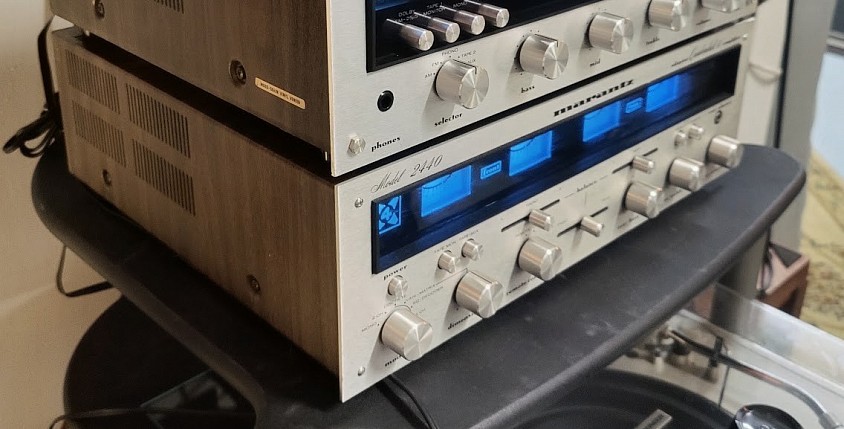
Marantz 2440
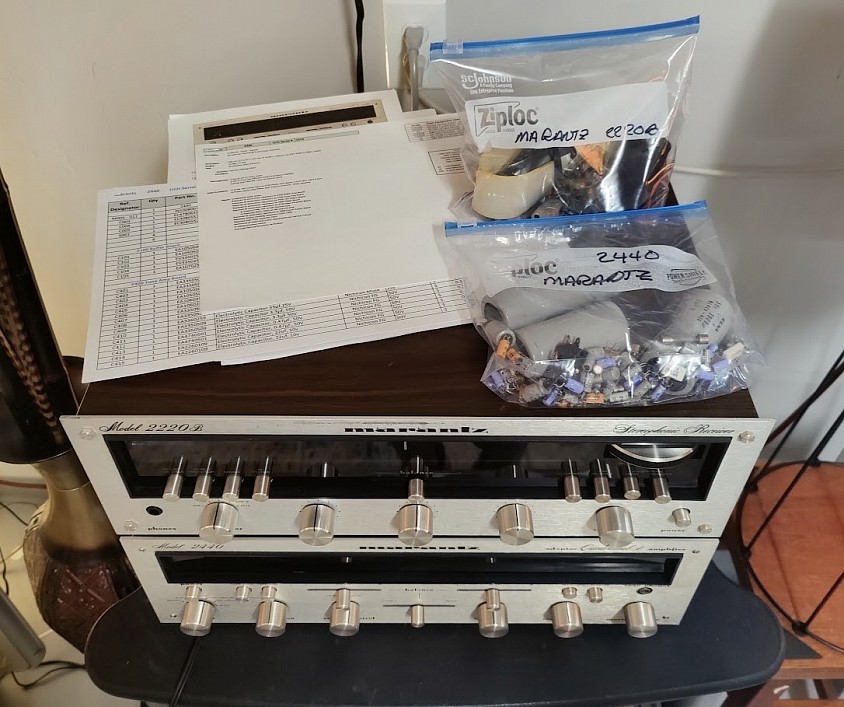
data and performance sheets, old parts, etc
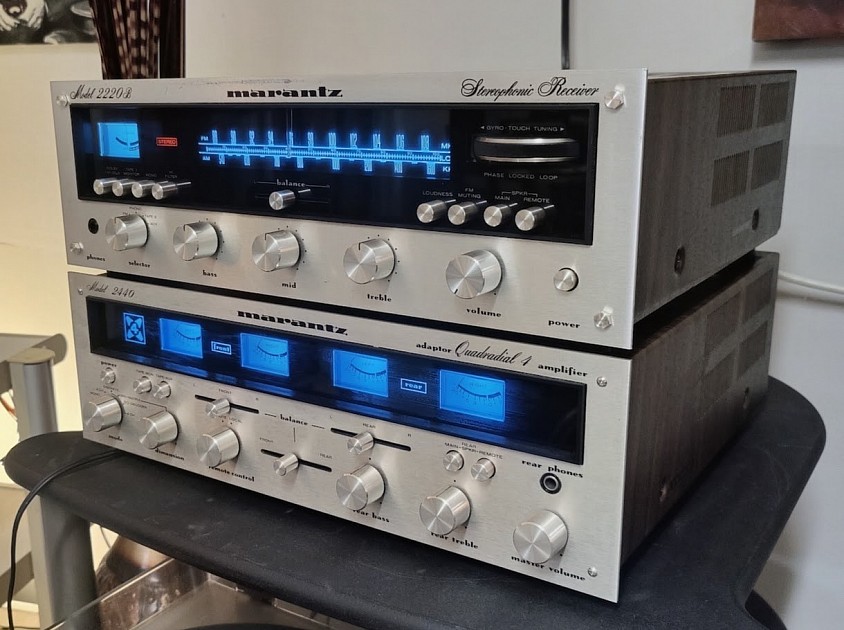
Marantz 2440 (bottom) Marantz 2220B (top) as setup for demo purposes
Marantz 2440
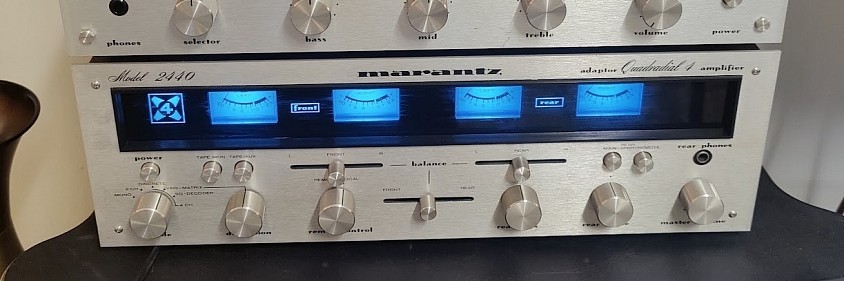
Marantz 2440
quad adapter amp ('72-'76) $1300
Recapped / Restored
This Marantz 2440 has been extensively serviced, recapped and restored in August 2026. The operation manual is included.
When first released in the early 70's, it was designed as a quad-adapter amp that could easily convert any stereo system into a full featured 4-channel system by simple connection (via the tape loop).
Even though it was labeled as a "quad system", you could consider this to be similar to what was later on called surround sound.
For 4-channel demo purposes (at the shop), we have this restored 2440 connected to our restored Marantz 2220B stereo receiver along with four speakers to give you an immersive sound experience. Of course, you could buy both units if so desired but they are also being offered as individual units for sale separately.
NOTE: The Marantz 2220B receiver is also available for sale and is described on the FEATURED RECEIVERS PAGE #1
When connected properly, all four meters are activated for a cool visual experience. It allows stereo listeners the ability to experience quad sound simply by using their existing equipment. As mentioned before, all that's needed is an unused tape-loop and another set of speakers.
Thanks to a few different controls on the 2440, your stereo system will then have you surrounded by simulated 3D effects and music in a whole new way. For example:
~Master Volume: This controls the output level. Note that in an adapter setup, the front speakers run through your stereo receiver while the rear speakers run directly off the 2440.
~Vari-Matrix: This optimizes Marantz's proprietary matrix effect to simulate four-channel sound from regular two-channel stereo sources
~Dimension Control: This specialized rotary knob is used exclusively to optimize the 4-channel synthesis effect when the unit is switched into its Vari-Matrix mode.
~Full 4-Channel Functionality: Ability to reproduce any discrete 4-channel program from an external source. Also accepts optional matrix decoder plug-in decoder for specific systems such as Columbia’s SQ or Electro-Voice’s Stereo 4 programming.
NOTE: SQA1 or 2A plugins are available for purchase separately.
NOTE: Marantz's exclusive "vari-matrix" circuit simulates 4-channel sound from normal 2-channel stereo programs. and is capable of reproducing 4-channel sound from any matrix encoded source. It will also reproduce any discrete 4-channel program as well as regular stereo and mono programs.
Services performed in August 2026:
Replaced meter lamps with Cool White LED
Replaced all electrolytic capacitors on P100 Buffer Amp Board
Replaced all electrolytic capacitors on P400 Tone Amp Board
Replaced all electrolytic capacitors on P500 Vari Matrix Board
Replaced all electrolytic capacitors on P600 Meter Board
Replaced all electrolytic capacitors on P700 Main Amplifier Board
Removed, tested and re-thermaled output
Replaced all electrolytic capacitors on P800 Power Supply Board
Replaced main power filter and both channel coupling capacitors
Performed all audio and meter adjustments per service manual
Executed final performance verification
Specs (after recap)
Power output: 25 WPC @ 8 ohms
30 WPC @ 4 ohms
Frequency response: 5Hz to 45kHz
THD: 0.12%
Dimensions: 17"W x 5"H x 14.5"D
Weight: 24 lbs.
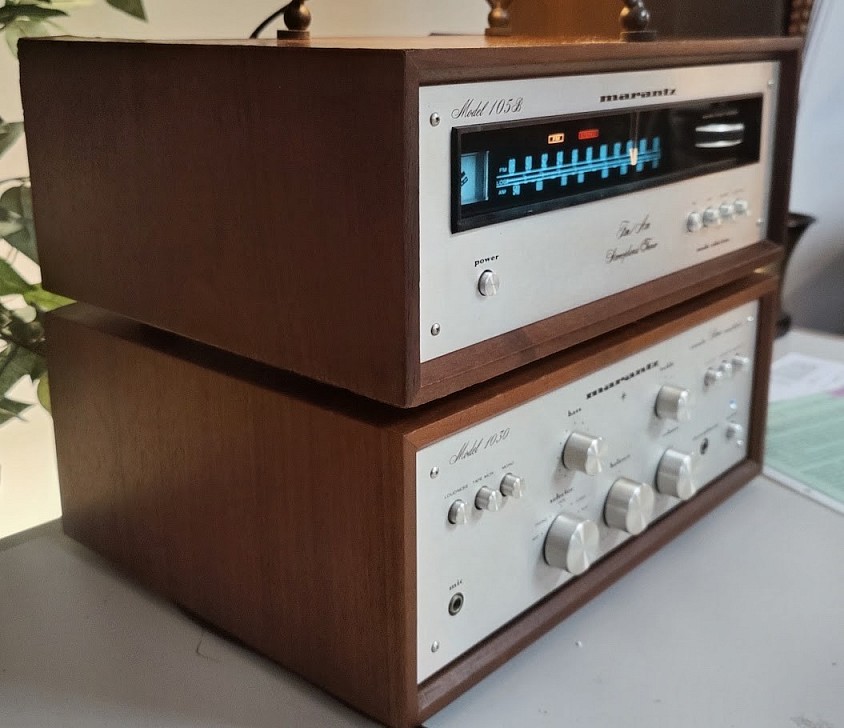
Marantz 1030 / 105B
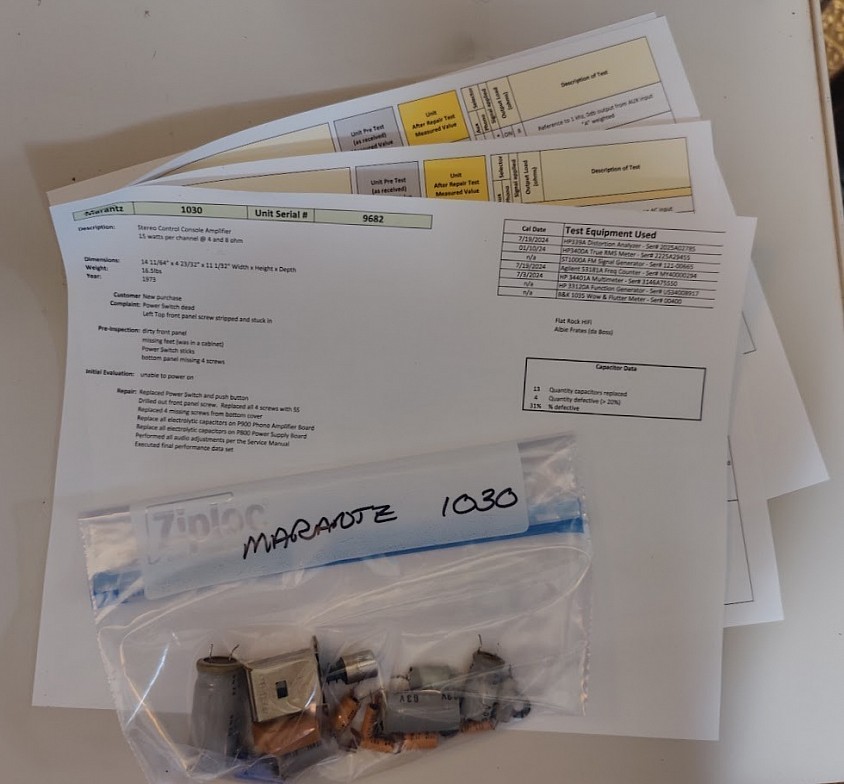
Marantz 1030 / 105B bench data / performance / test packet
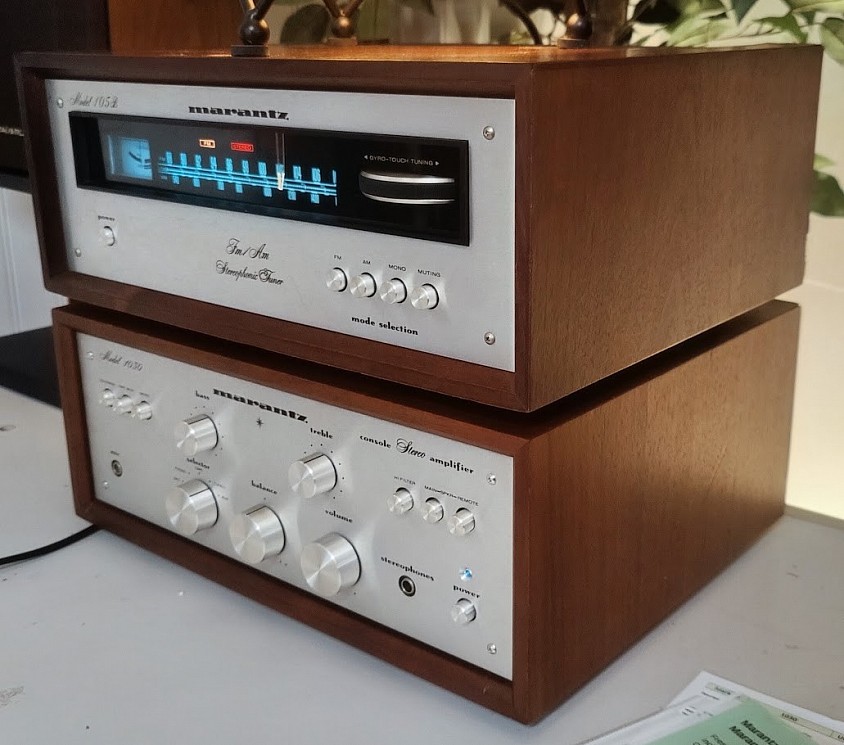
Marantz 1030 / 105B
Marantz 1030 / 105B
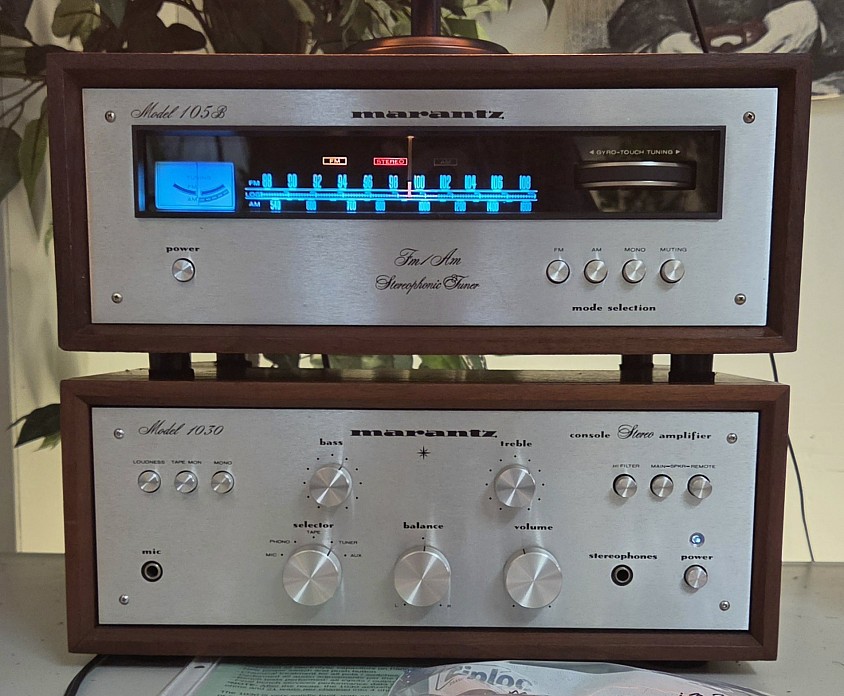
Marantz 1030 / 105B
integrated amp / tuner ('73-'76) *16.5 WPC $1200 / set
Fresh off the bench that included a partial recap...this stunning set of restored vintage Marantz components includes the 1030 stereo console (integrated amp) and the 105B stereo tuner. Cosmetics on both units are pristine and both units come with the factory Marantz WC-10 case.
The Marantz 1030 & 105B come from a series of beautiful and highly collectible Marantz models produced during the '70's, sometimes referred to as the "Golden Age of HiFi".
They are physically described as "compact" components since they are slightly smaller than the typical 22xx series of receivers.
They are being offered as a set only.
*Bench services ~ 1030 (July 2026)
~Replaced all electrolytic capacitors on P900 phono amplifier board
~Replaced all electrolytic capacitors on P800 power supply board
~New power switch and push button
~Chemical treatment for all pots / switches / etc (tuner included)
~Performed all audio adjustments per the service manual
~Bench tests performed: all inputs / outputs / controls
~Installed new vellum and new "frosted cool white" LEDs
~Final bench services performance data / test packet included with units
*NOTE: After the recap, the 1030 actually puts out an honest 16.5 watts per channel into 8 ohms and 21 watts per channel into 4 ohms.
The 1030 is very solidly built, with all metal construction, and no switching power supplies or integrated circuits. That solid construction conceals the real, usable power of this "baby" Marantz 1030. So, in a nutshell, you get great sound, great looks, excellent functionality. It has all the necessary functions you need like the tape loop, phono, tone controls, loudness, high filter and headphone output. For some folks, gobs of power are not what they're always looking for. Remember, it's ALWAYS about your choice of speakers! About the loudness switch on the 1030 (and certain other Marantz amps): When activated, the loudness button is "tied" to the volume knob. When the volume is turned down, the bass gets more emphasized (just right we might add). It could be one of the reasons why people love this amplifier. It's all about the bass!
The complimentary 105B stereo tuner features an analog dial, FM/AM tuning meter, the famous "Gyro-Touch" tuning wheel, push button switches for FM, AM, Mono and Muting.
NOTE:
As with all Marantz units that have FM, we always remove the old faded vellum and incandescent lamps. We replace it all with new fresh vellum and new frosted "cool white" LEDs. Now, the iconic blue glow is perfect. That always adds to that much admired Marantz appeal.
Essențial specs (1030):
Power output: 16.5 WPC into 8 ohms / 21 WPC into 4 ohms
THD: 0.06%
Dimensions: 15.5"W x 13"D x 6"H (same for tuner)
Weight: 20 lbs (including case)
+++++++++++++++++++++++++++
+++++++++++++++++++++++++++
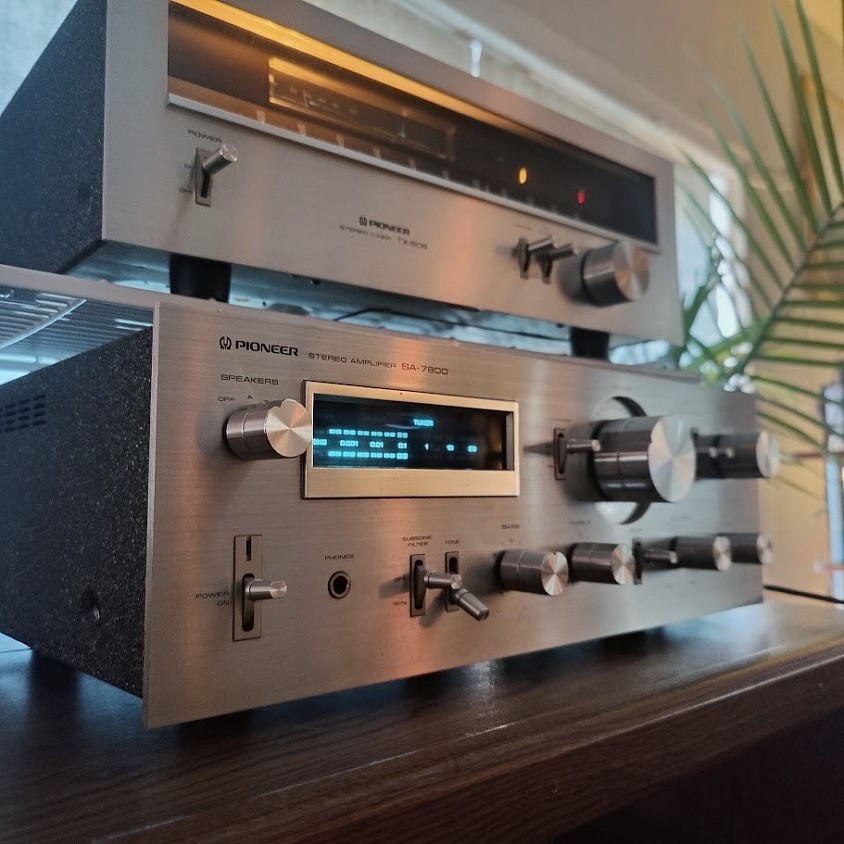
Pioneer SA-7800 / TX-680
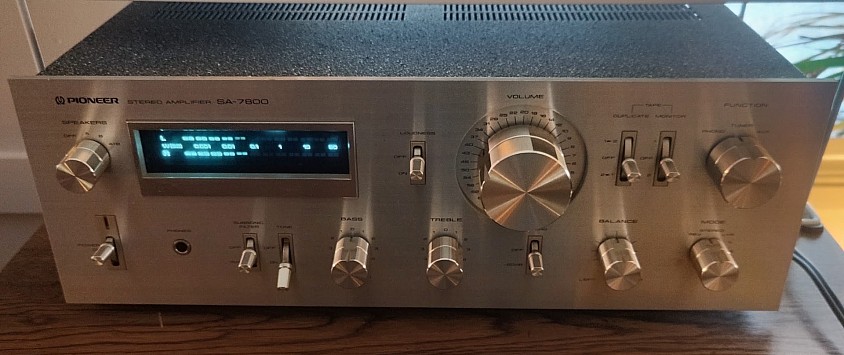
Pioneer SA-7800 / TX-680
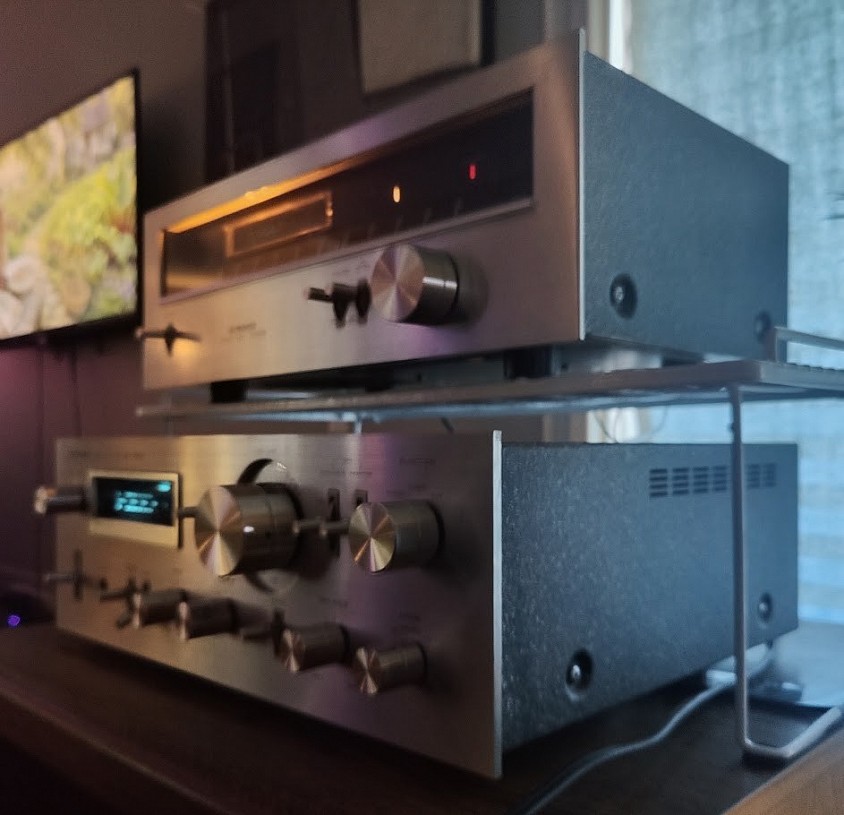
Pioneer SA-7800 / TX-680
Pioneer SA-7800 / TX-680
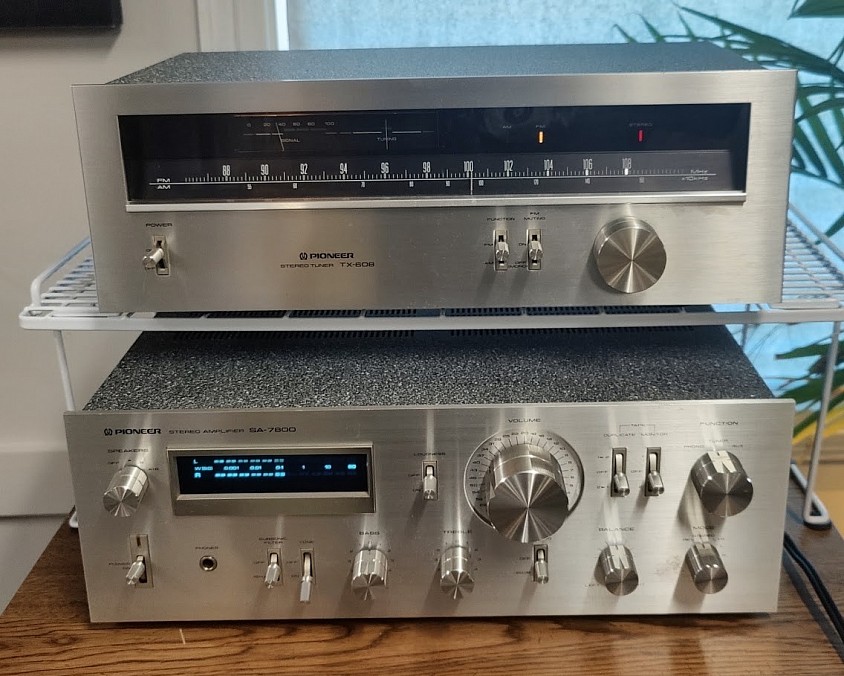
Pioneer SA-7800 / TX-680
integrated amp / tuner ('79-'81) 65 WPC
$900 (sold as set only
This Pioneer SA-7800 and TX-608 were obtained from the original owner. They are both in excellent cosmetic condition, fully serviced, fully tested and fully operational. It comes with a custom stone mineral textured case.
As per our usual disassembly / deep clean / inspection / reassembly, etc the servicing also included pots, switches, bias and thorough testing. The tuner was calibrated for optimum reception (depending on your location when used with a proper antenna)
Probably the first thing noticeable (when powered up) would be the beautiful (and stunning) fluoroscan meters along with those massive knobs! The SA-7800 is a super fast, super quiet unit featuring Pioneer's "non-switching" amp section.
At a hefty 35 lbs, this SA-8800 was second only to the SA-9800 but was (is) still one of their very best integrated amps built with the current state-of-the-art technology that was available from Pioneer in the late 70's / early 80's. Certainly, along with the SA-9800 and the SA-8800, the SA-7800 was one of their very best integrated amps of all time.
Features:
~A protective circuit with a built-in relay is mounted to suppress noise when power is turned on/off.
~The tone circuit is a 2-stage direct-coupled circuit
~The massive volume knob uses a full-scale attenuator type volume with 22 contacts, and uses high-precision printing resistors to reduce gang errors. It also has a 3-step lever type attenuator.
Basic specs:
Power output: 65 WPC @ 8 ohms
Frequency response: 5Hz to 100kHz
THD: 0.005%
Dimensions: 18.8"W x 6"H x 17.7"D
Weight: 28 lbs
The Pioneer TX-608 stereo tuner has an analog dial housed in a custom stone mineral textured case. It features signal strength and tuning meters, Stereo indicator, Function switch (FM, AM), FM Muting On/Off switch, built-on adjustable ferrite loopstick AM antenna, terminals for AM and FM (300 ohm balanced and 75 ohm unbalanced) antenna and RCA phono Line Output sockets.
+++++++++++++++++++++++++
+++++++++++++++++++++++++
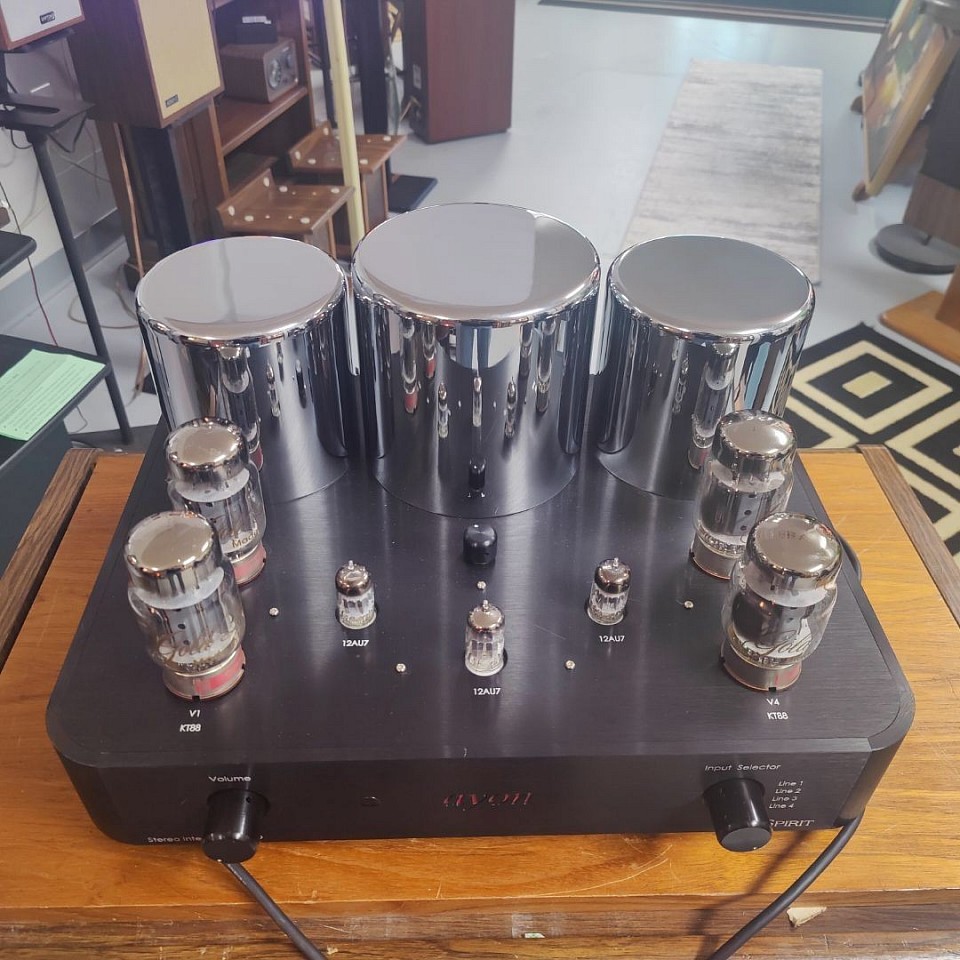
AYON Spirit
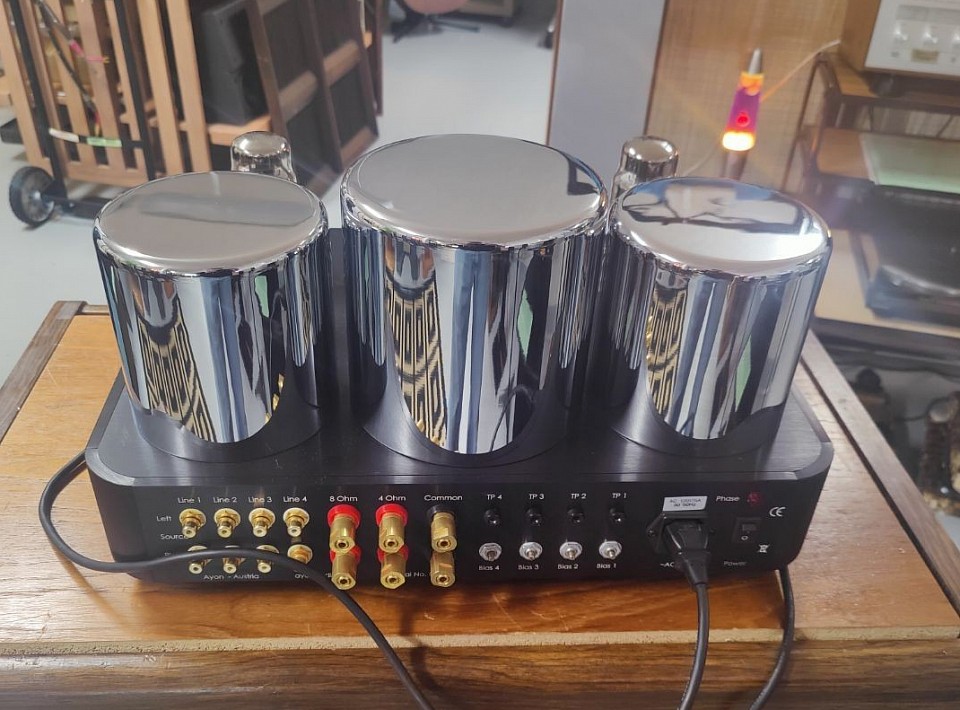
AYON Spirit
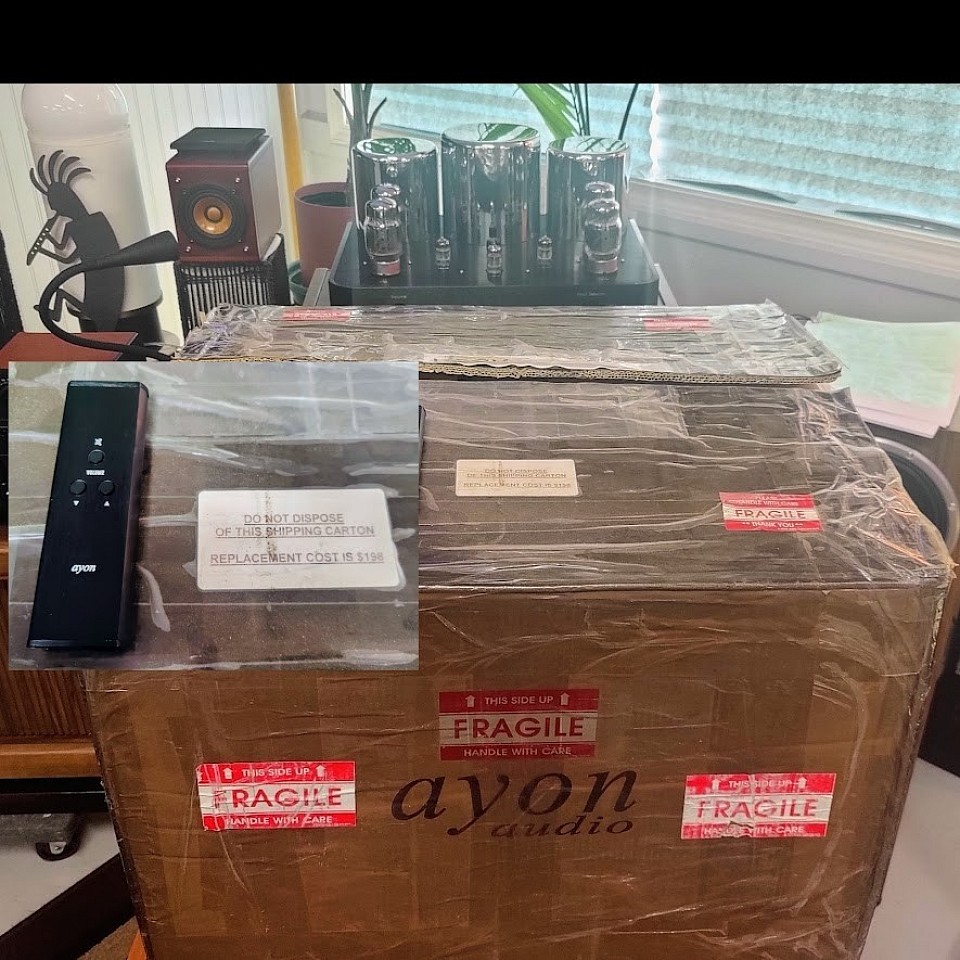
AYON Spirit factory box & remote
Ayon Spirit 1
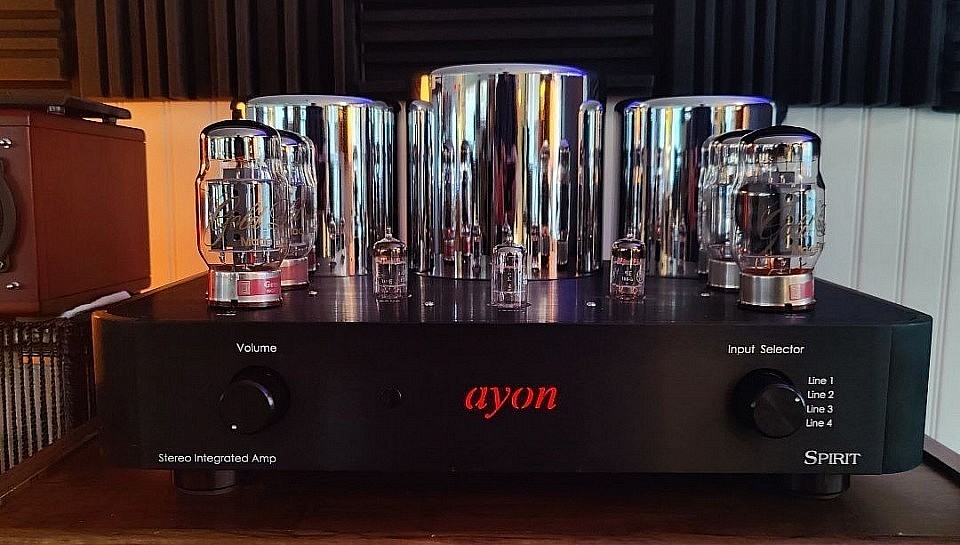
Ayon Spirit 1
Integrated Amplifier 65 WPC Class A (2008) $2400
First released in 2008, it is one of the "Holy Grail" Pentode/Triode Pure Class A stereo integrated tube amps. This one has new Russian made Genalex Gold Lion KT88 reissue vacuum tubes. It also comes with the original factory remote control and a very sturdy, factory-built, triple-boxed shipping container and materials. It should be noted that Ayon charges $180 for a replacement shipping box.
The Spirit uses the previously mentioned four KT88 and three 12AU7 tubes. It is a zero negative feedback design and runs in pure Class A. The preamp section has four line levels and there are speaker taps for both 4-ohm and 8-ohm impedance.
Though an integrated, the Spirit occupies a spot on the audiophile spectrum where convenience features give way to more purist priorities. The black brushed aluminum remote control was designed to match the amp’s finish. It's a simple remote that controls volume and muting only.
On the amp itself, there are no non-essential front panel buttons of any kind: no balance control, no tone controls, and no mono button. The amp not only has fully manual tube biasing, but has located this important feature on the back panel. The power switch is also located in the back. Because of its "lack" of certain controls, some may say that the Spirit might not rate high in convenience, but with its performance being the main attraction...enough said!
Ultra-linear electronic circuits are those used to couple a tetrode/triode or pentoden vacuum-tube to a load (e.g. to a loudspeaker). ‘Ultra-linear’ is also known as ‘distributed loading’; a circuit technique patented by Alan Blumlein in 1937. Ultra-Linear “distributed loading” was intended for guitar amps, etc.
• In pentode or triode, in which the screen-grid is connected to a stable DC voltage so there are no signal
variations on the screen-grid (i.e. the screen-grid has 0% of the plate’soutput signal impressed on it)
• In triode, in which the screen-grid is connected to the plate (i.e. the screen-grid has 100% of the plate’s output signal voltage impressed on it)
• a blend of triode and pentode, in which the screen-grid has a percentage (between 0% and 100%) of the plate’s output signal impressed on it. This is the basis of the Ultra-Linear “distributed load circuit” and is seen as a form of feedback,
which alters the behavior of the electron stream passing from cathode to anode.
Ultra-linear introduces negative feedback, which squashes and compresses the sonic performance.
So the Pentode/Triode operation will yield a vastly superior response and more of a “tactile” or SET sound, more of a three dimensional sonic signature. Quite Superior!
NOTE: All of Ayon Audio’s products are painstakingly designed and assembled in-house; the company even makes their own tubes. While they specialize in low-powered, single-ended designs, the Spirit integrated is the company’s ostensible attempt to craft a more mainstream offering: switchable between push-pull pentode and triode operation, the Spirit pumps out a robust 60-watts per channel in pentode and 40-watts in triode. With the original list price of $4500, the Spirit and the similar, triode-only Spark integrated, were Ayon’s twin entry-level offerings. Entry-level it may be, but the Spirit is still a gorgeously built amp. Having it in your listening room will instantly identify you as someone who is quite serious indeed about their music playback.
+++++++++++++++++++++++++
+++++++++++++++++++++++++
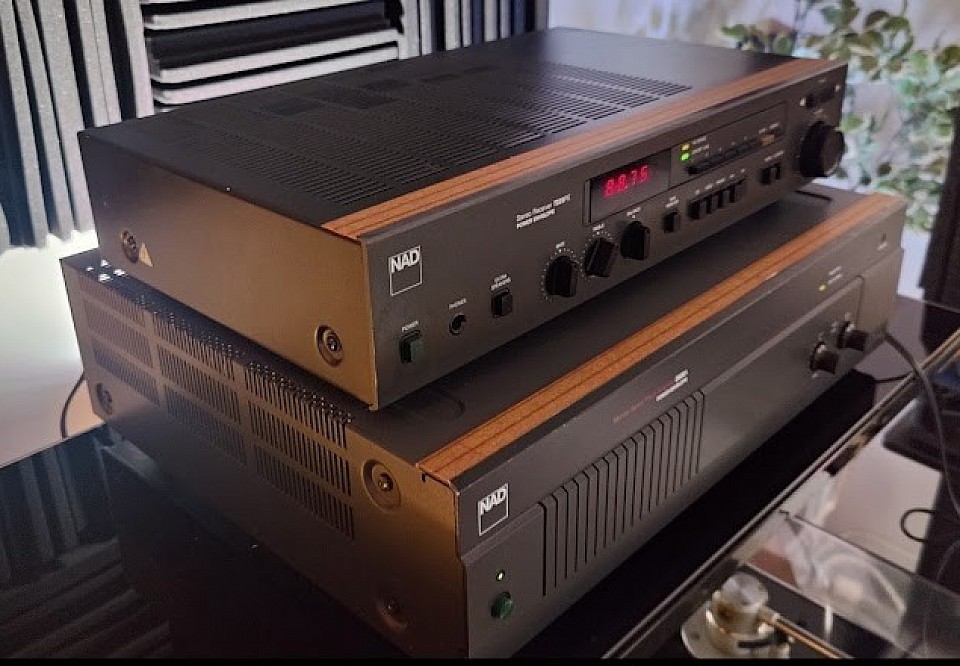
NAD 2600A
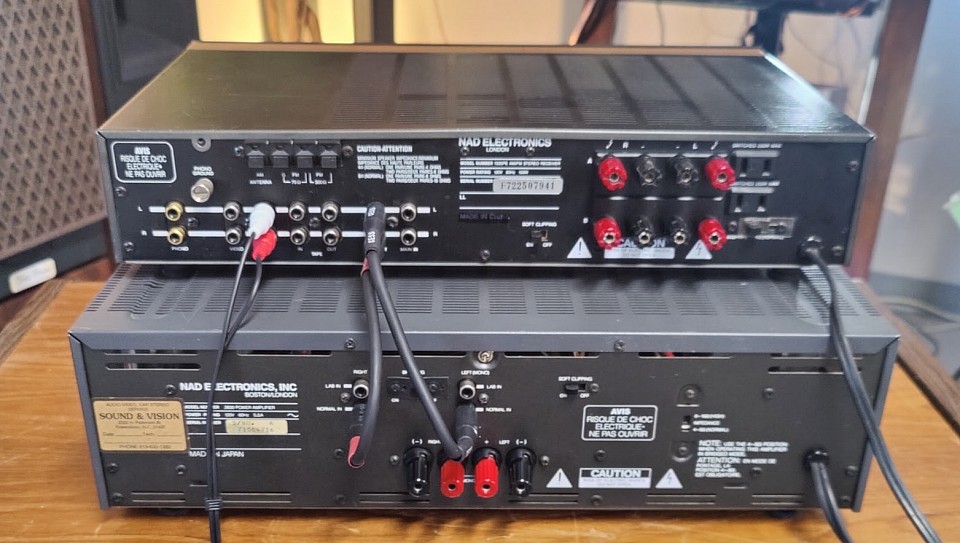
NAD 2600A
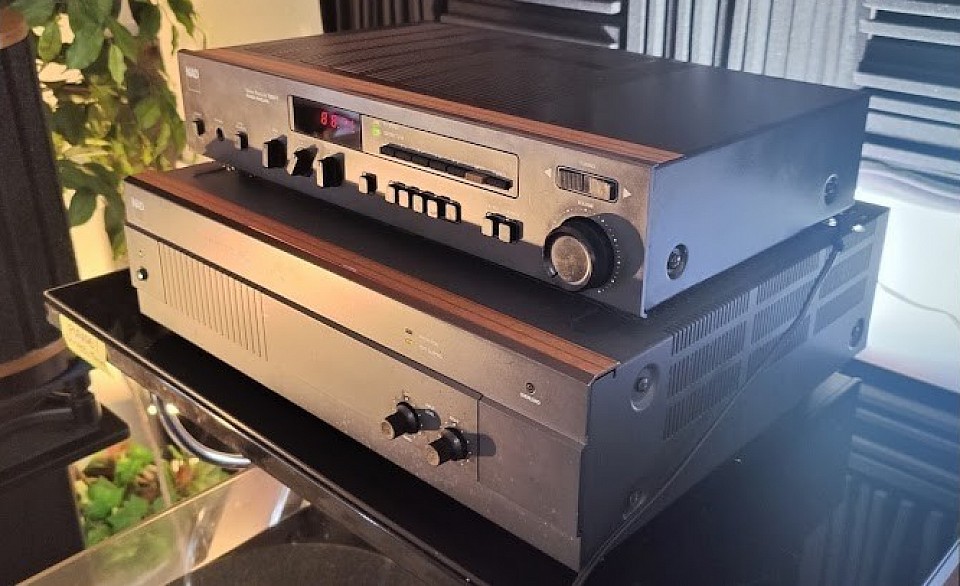
NAD 2600A
NAD 2600A
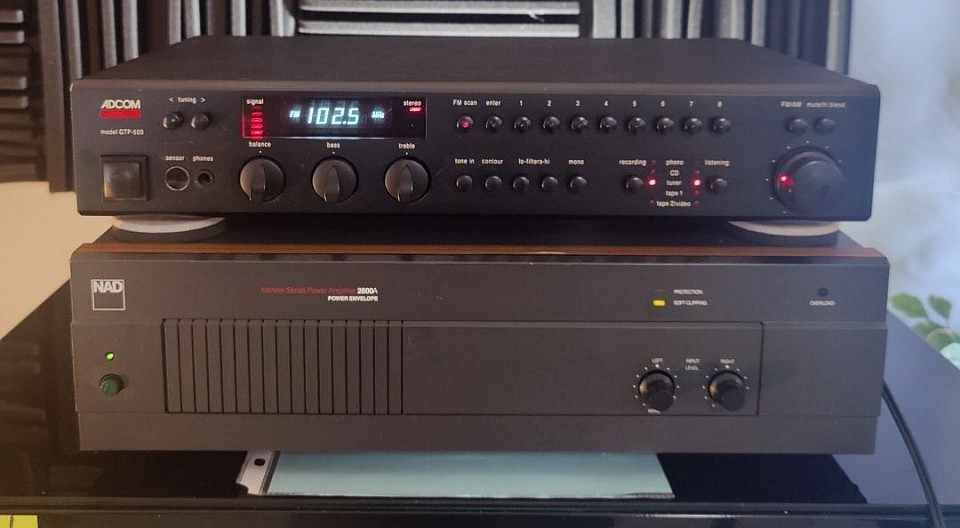
NAD 2600A
stereo power amp ('88-'89) $500
150 WPC
In excellent cosmetic condition, fully bench serviced and thoroughly tested, this NAD 2600A monitor series stereo power amp is a rare and heavy duty brute.
NOTE: We have several preamps available at extra cost. Examples are shown in the photos.
The back story:
The NAD 2600 series was an evolution of the NAD 2200. The 2600 can have “B” or “C” series main amp boards but the best of the 2600 series is the one we have here, the 2600A. That's primarily because it has “C” series amp boards. Some 2600’s and all 2600A’s have an upgraded input board with additional transistors regulating the 18v supply rails. This is the SW 692 board. These upgrades included providing front panel volume controls for each channel and replacing the metal front panel of the 2200 series with a plastic panel. The main power rails have been raised to 72v, from the 65v of the 2200 series, enabling NAD to claim a power output of 150 watts per channel compared to the claimed 100 watts of the NAD 2200. This additional voltage is provided by a different transformer, which has switchable taps for different impedance speaker arrangements on the rear.
Specs:
Power output: 150 watts per channel into 8 ohms (stereo)
Frequency response: 20Hz to 20kHz
THD: 0.05%
Speaker load impedance: 4 ohms (minimum)
Dimensions: 17.2"W x 5.5"H x 15.5"D
Weight: 29 lbs
About NAD...
Based in London, NAD is a great audio company and has made a number of very notable, and now vintage, amplifiers. Their philosophy has been driven by making their amplifiers sound “musical”, though at a price point that us mere humans can afford. One of their key innovations is using a dual rail power supply with two voltages, with the higher rail providing a reserve of power that is used for musical transients.
It's well known throughout the vintage HiFi community that NAD makes very good amplifiers. The circuits are well thought out and the core components are well considered. In some of their models their choice of components has been driven by cost, and as such replacing these with modern components does return a noticeable benefit.
++++++++++++++++++++++++++++++
++++++++++++++++++++++++++++++
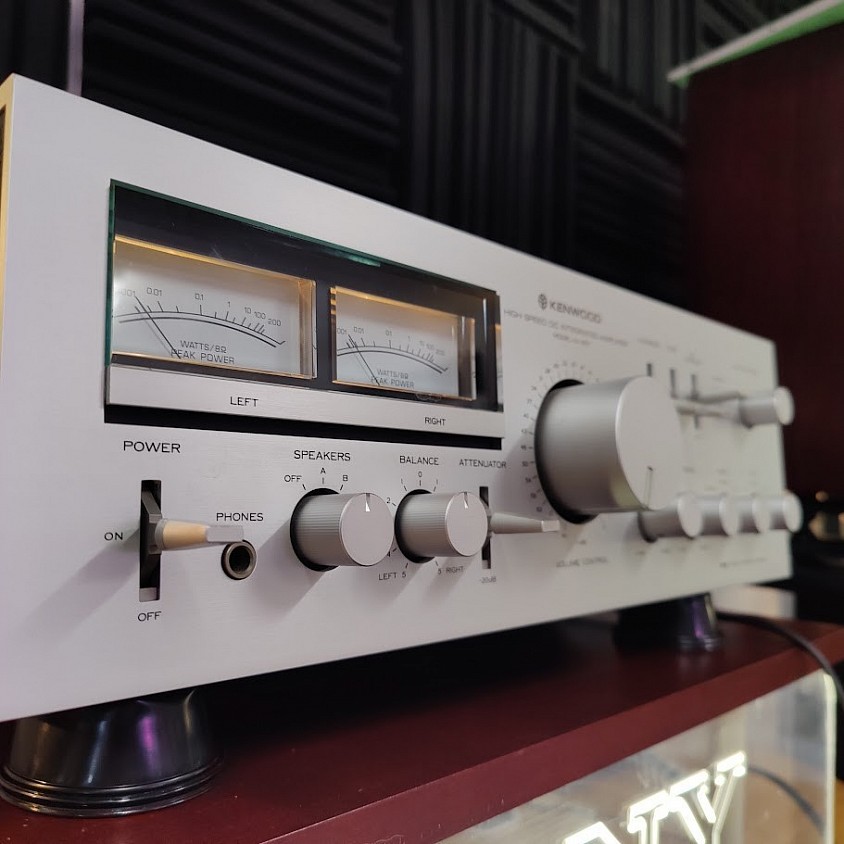
Kenwood KA-801
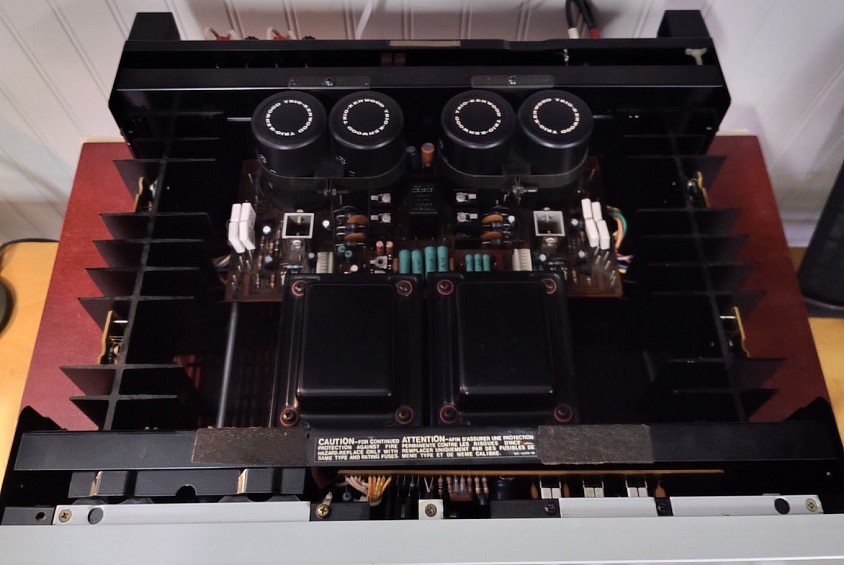
Kenwood KA-801 bench nudie
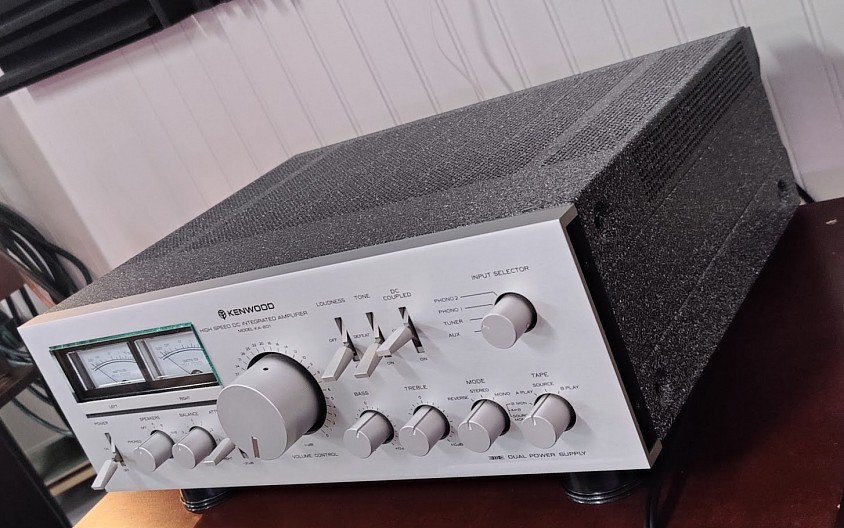
Kenwood KA-801
Kenwood KA-801
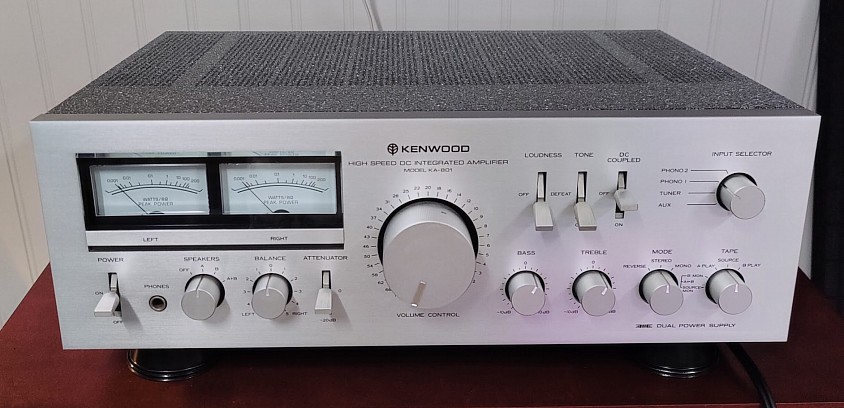
Kenwood KA-801
integrated amp ('79-'81) $650
(partially recapped)
110 WPC @ 8 ohms / 160 WPC @ 4 ohms
In excellent cosmetic condition, fully bench *serviced and fully operational, this Kenwood KA-801 integrated amp is a "power house amp" putting out a minimum of 110 watts per channel into 8 ohms and 160 watts per channel into 4 ohms. This is a dual-mono design (dual power supplies) and was definitely one of the best Kenwood amps made in the late 70's. The distortion level in the 801 is so ridiculously low that even a doberman pinscher probably couldn't hear anything.
The beautiful faceplate design features large, illuminated dual power meters and it has a high-quality chassis to hold all the components inside.
Too many features to list but some of the main would be the DC on/off switch, dual phono inputs, precision attenuators, tone defeat, and independent L/R power supplies.
NOTE: As for the DC Coupling switch, Kenwood rated this amp as being flat from DC-400kHz (-3dB) DC Coupled, and 18 Hz-400kHz with the DC Coupled switch set to off. The effect is similar to a rumble filter.
The metal case has been upgraded with a beautiful gray stone textured coating. Photos do not do it justice; seen in person it looks excellent.
It should be noted the KA-801 pulls over 700 watts from the wall when pumped up. (obviously, a high quality surge protector is a must for any of these powerful amps)
*Service included:
Disassembly of internal components
DC offset and bias adjustment (DC preamp trim pots)
Partial recap of the feedback loop
Chemical treatment of all pots/ switches
All inputs / outputs / switches and connections tested, 100% functional
Essential specs:
Power output: 110 WPCinto 8 ohms
160 WPC into 4 ohms
Frequency response: 20Hz to 20kHz
THD: 0.015%
Dimensions: 17.5" x 6"H x 16"D
Weight: 39 lbs
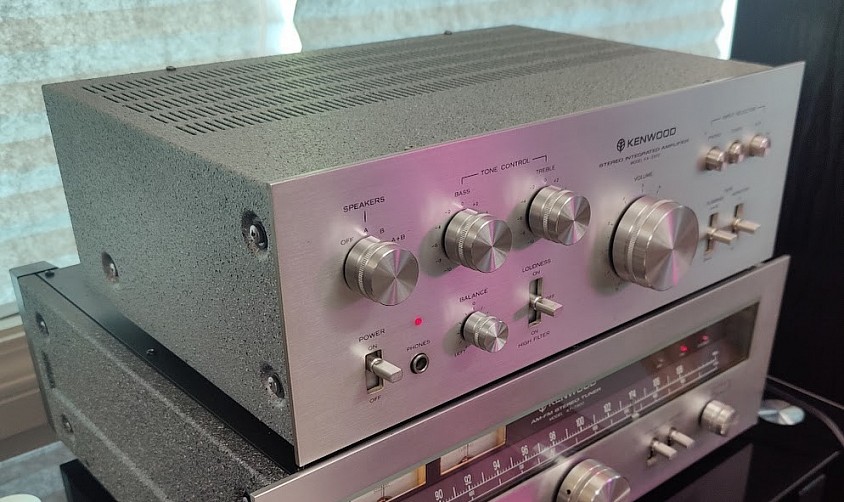
Kenwood KA-3500
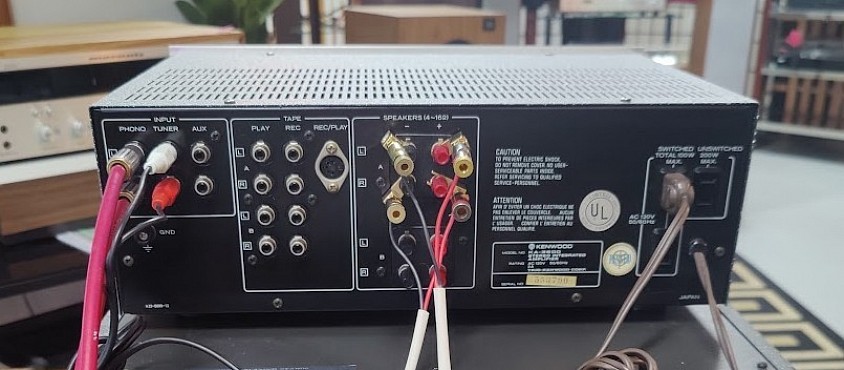
Kenwood KA-3500
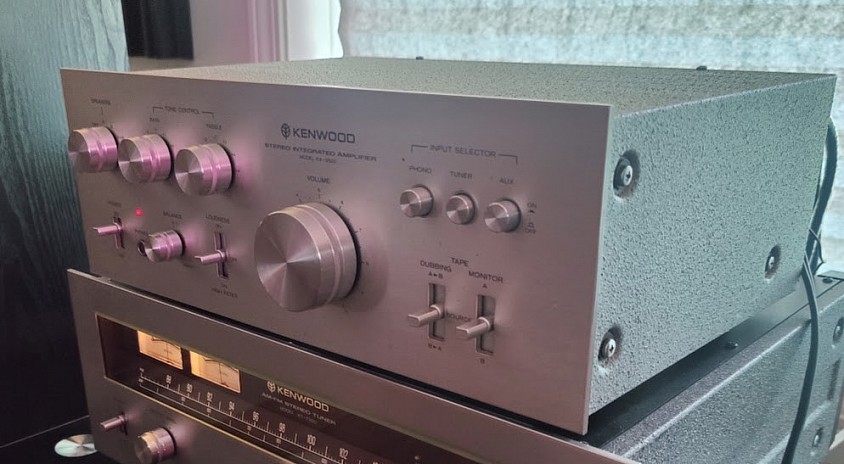
Kenwood KA-3500
Kenwood KA-3500 / KT-313
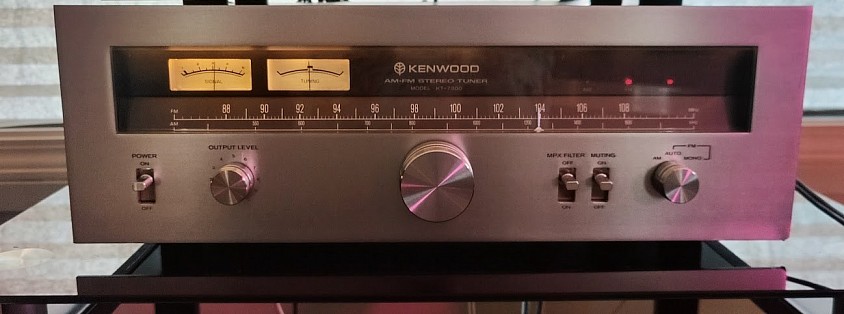
Kenwood KA-3500
integrated amp ('75-'77) 40 WPC $450
Obtained locally from the original owner, this Kenwood KA-3500 integrated amp is beautifully simplistic in design and very well built indeed. After our intensive bench servicing and testing, it's literally in mint cosmetic condition and performing perfectly. Both the amp & tuner cabinets feature a unique and very attractive graystone mineral textured finish.
There's something special about these mid-70's Kenwood integrated amps; they are one of our favorites among the hordes of mid-size amps available during the frenzied 70's marketplace. Even today they are extremely desirable for their durability and smooth exterior designs. As some have stated (and we definitely agree with) "the Kenwood KA-3500 has the aesthetics and build quality that simply oozes '70s vintage class."
The KA-3500 was positioned as a mid-level component amplifier in Kenwood’s '75-'77 product lineup. The very conservative power rating of 40 watts per channel into 8 ohms (45 WPC into 4 ohms) put the KA-3500 in direct competition with the Pioneer SA-7500 (which was also powered at 40 WPC). This great looking "Kenny" is really one of the sweetest sounding amplifiers from the era, with plenty of detail and enough power to drive most mid-level systems with ease. Features include inputs for turntable, tuner, two decks and auxiliary, with dubbing support provided. Reviews claim this was (and still is) one of the best sounding amps in its price range
In excellent cosmetic condition and working perfectly, the KT-313 stereo tuner is included
Basic specs:
Minimum power output: 40 WPC @ 8 ohms / 45 WPC @ 4 ohms
Frequency response: 20Hz to 20kHz
THD: 0.2%
Dimensions: 15"W x 5.5"H x 10"D
Weight: 22 lbs
About Kenwood...
Kenwood’s roots trace back to 1946, when it was originally founded in Komagane City, Japan as the Kasuga Radio Co. Ltd. The company initially focused on producing amateur radio and communication equipment, catering to a post-World War II market where radio was a primary means of communication. In the early years, Kenwood quickly gained a reputation for its technical expertise and high-quality components, establishing itself as a leading manufacturer in the Japanese electronics market.
In 1960, the company changed its name to Trio Corporation to reflect its broader ambitions. Around this time, the brand expanded its product line beyond radio communication equipment, venturing into consumer audio products, including amplifiers and receivers. The early '60s also marked the company’s entry into the international market, with its first overseas office established in the United States.
The name Kenwood came into existence in 1961 when Trio Corporation’s products began to be marketed under the Kenwood brand in the U.S. The name “Kenwood” was chosen to appeal to an international audience, as it combined the popularity of the name “Ken” with the term “wood,” evoking strength and reliability. The new brand name resonated well with consumers, and over the next decade, Kenwood would become a well-known name in both consumer and professional audio markets.
In the '70s, Kenwood expanded into high-fidelity audio equipment, releasing a range of products including amplifiers, tuners, and receivers that offered excellent sound quality at competitive prices. The brand quickly earned a reputation for delivering innovative, feature-rich products that appealed to audiophiles and casual listeners alike. Kenwood’s early success was driven by its commitment to quality and its pioneering approach to audio engineering.
+++++++++++++++++++++++++
+++++++++++++++++++++++++
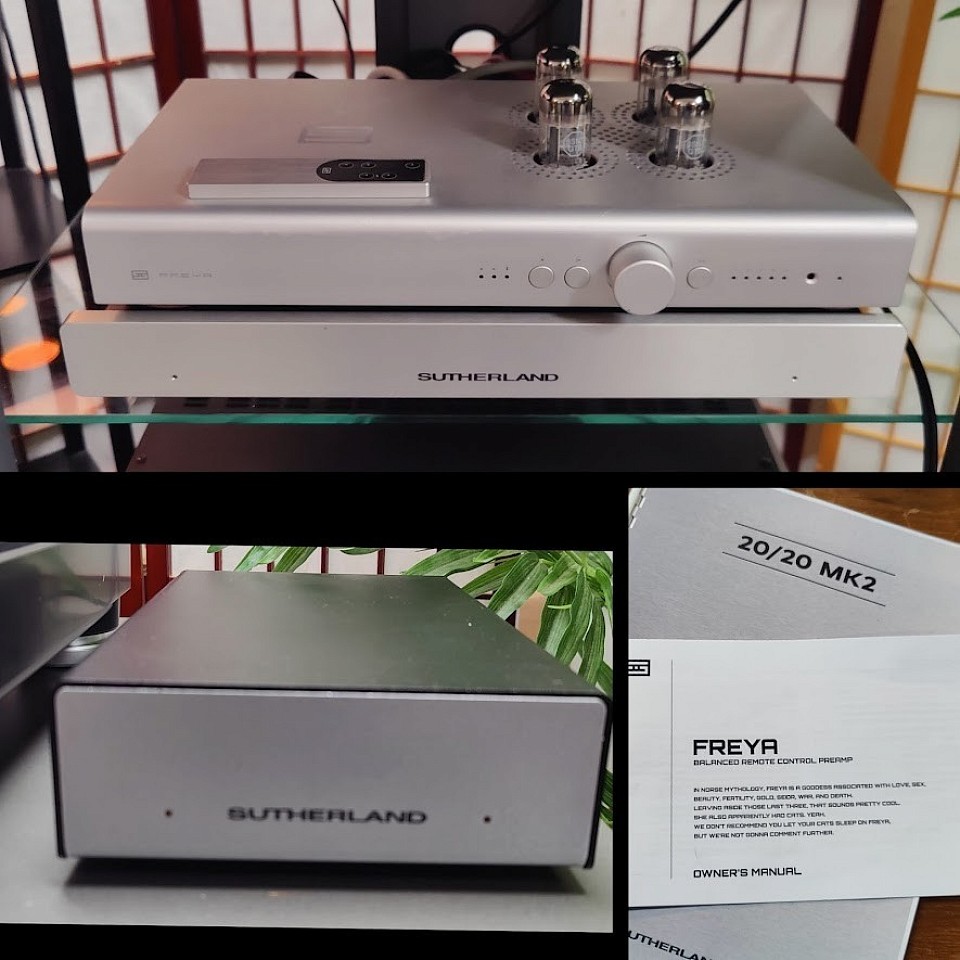
Schiit & Sutherland Engineering
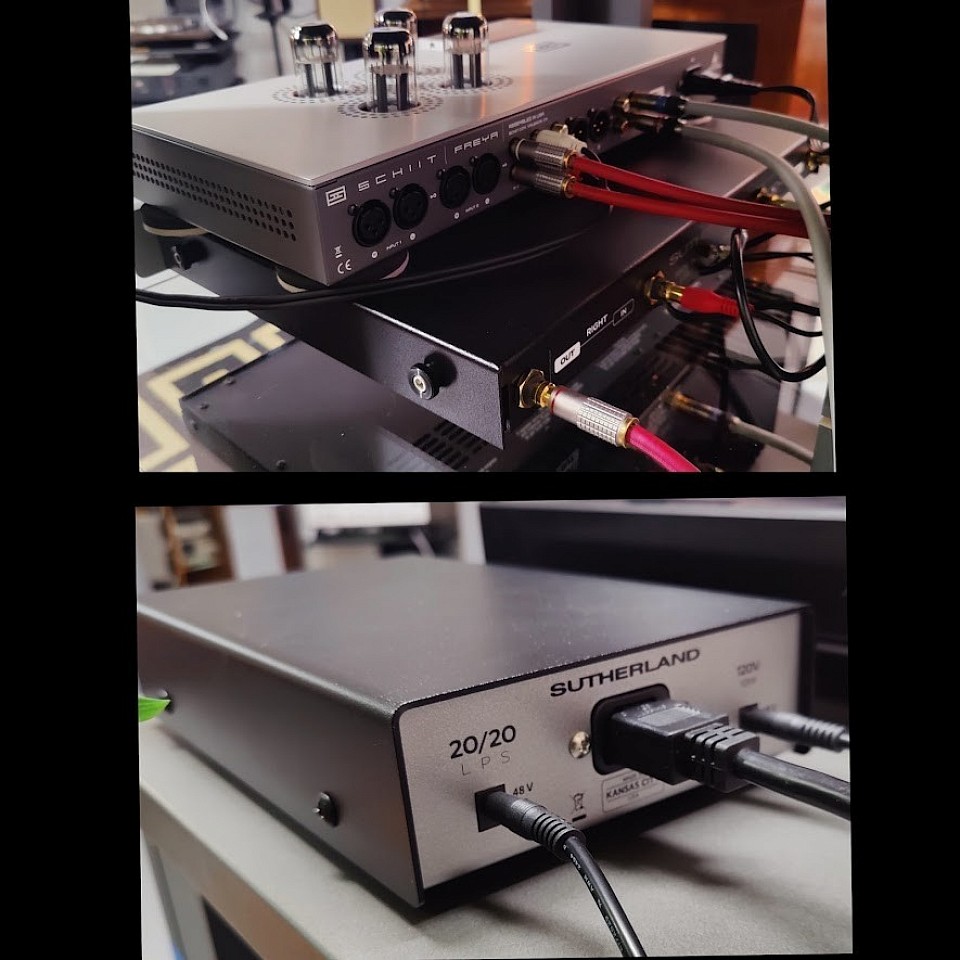
Schiit & Sutherland Engineering
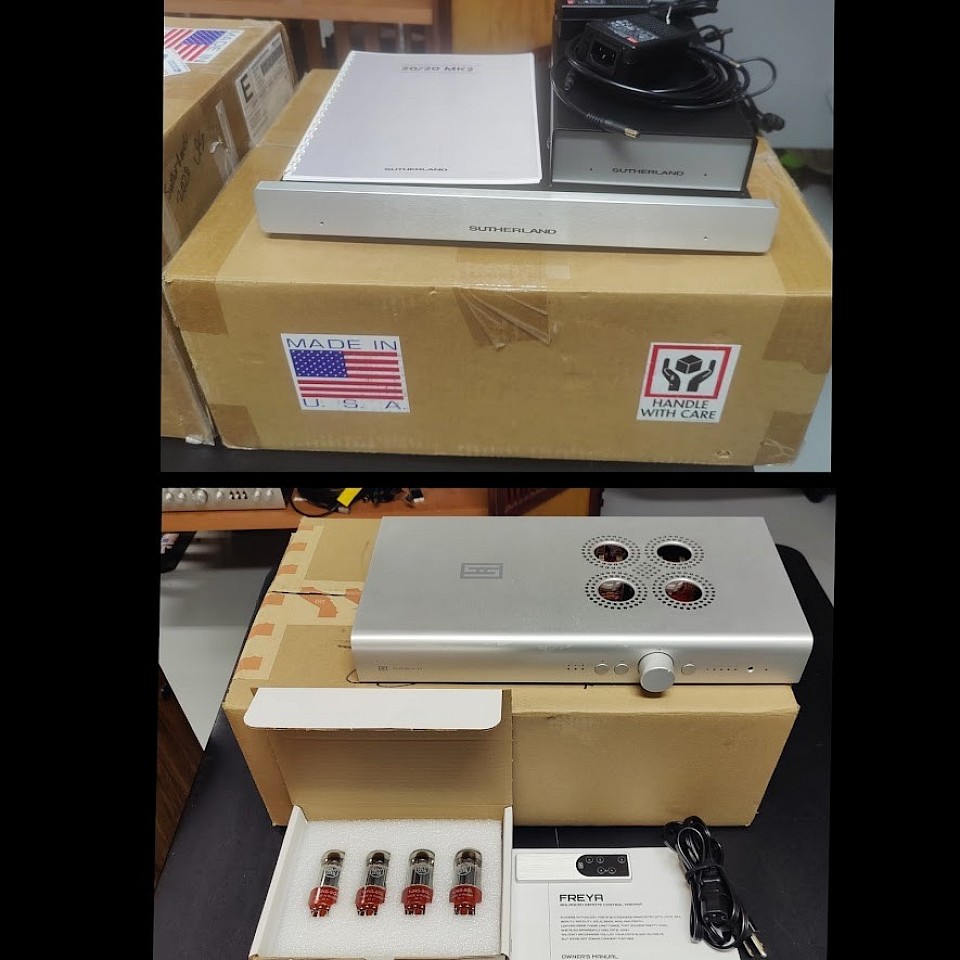
Schiit & Sutherland Engineering
Sutherland Engineering 20/20 MK2Schiit Freya Plus
Sutherland 20/20 MK2 preamp w/ LPS $1850
Schiit Freya + tube preamp ('19-current) $950
Fully operational and in mint cosmetic condition, these fine components were obtained from the original owner. The original factory boxes and documentation are included. They are available separately or as a complete set.
From Sutherland's website:
What is the 20/20 MK2 and who needs it?
The 20/20 is a phono preamp that comes in one compact chassis, there are two identical circuit boards. One for the RIGHT channel and one for the LEFT channel. Each has it’s own shielded compartment and each has it’s own power supply. Thus it is truly a DUAL MONO implementation of a stereo phono preamp.
It performs beautifully and brings pleasure to music lovers all over the world. The design has proven to be rock solid with long-term stability and reliability.
https://sutherlandengineering.com/20-20/
The Schiit Freya+ F is a true high-end, balanced, remote-control preamp. Switch between passive, differential buffer, and differential tube gain modes, and enjoy the fine control of a 128-step relay-switched stepped attenuator volume control with perfect channel matching.
Whisper-Silent Tube Stage—With Tube Shutdown
Now, you can enjoy a tube preamp without the hiss and hum of classic designs. Freya+ offers super-quiet tube modes with DC heaters and semi-circlotron, noise-cancelling output stages. Better yet, the tubes turn off when you’re not using them! That’s right, both the tube heater and high voltage rails go away when not in use, so you can preserve lifetime of costly tubes.
The Ultimate Volume Control
The benefits of a relay-switched stepped attenuator for volume are clear. Compared to a potentiometer, they give you essentially perfect channel matching and near-unmeasurable distortion. However, some preamps with relay-stepped attenuators confuse you with buttons and screens. Not Freya+. Freya+ has a volume knob that works just like a volume knob—just grab and turn.
Designed and Built in the USA
By “designed and built in the USA" this is what we mean: the vast majority of the total production cost of Freya+ F—chassis, boards, transformers, assembly, etc—goes to US companies manufacturing in the US. Our chassis, transformers, PCBs, and assembly are all from California, and all Freyas come together in our San Antonio, Texas production facility.
https://www.schiit.com/products/freya-f
+++++++++++++++++++++++++
+++++++++++++++++++++++++
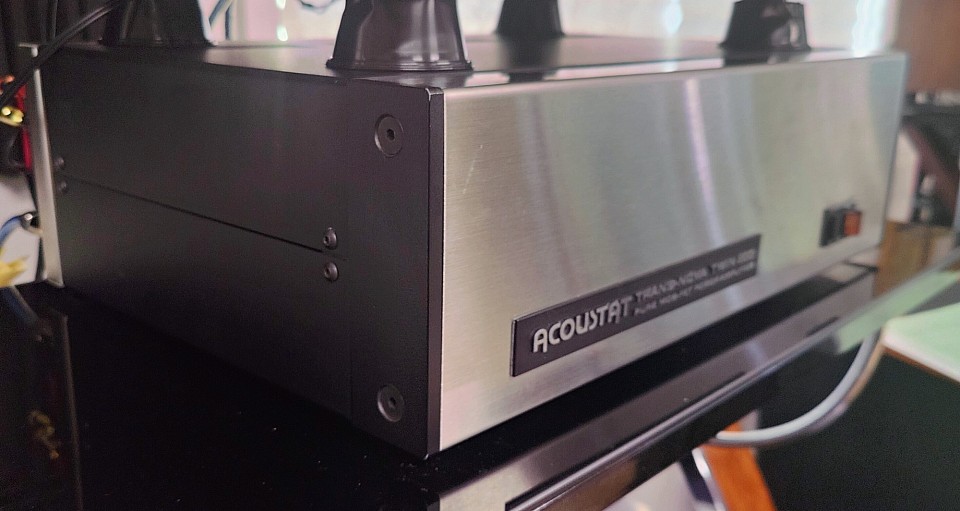
Acoustat Trans Nova Twin 200
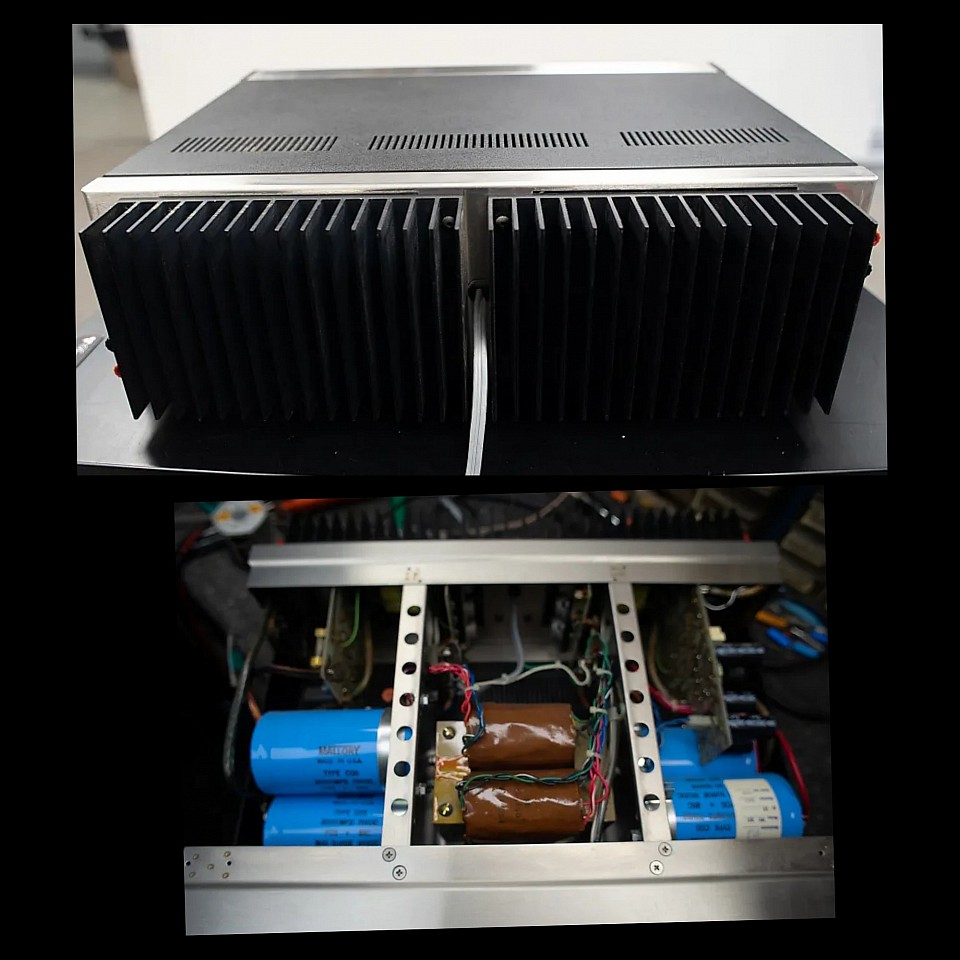
Acoustat Trans Nova Twin 200
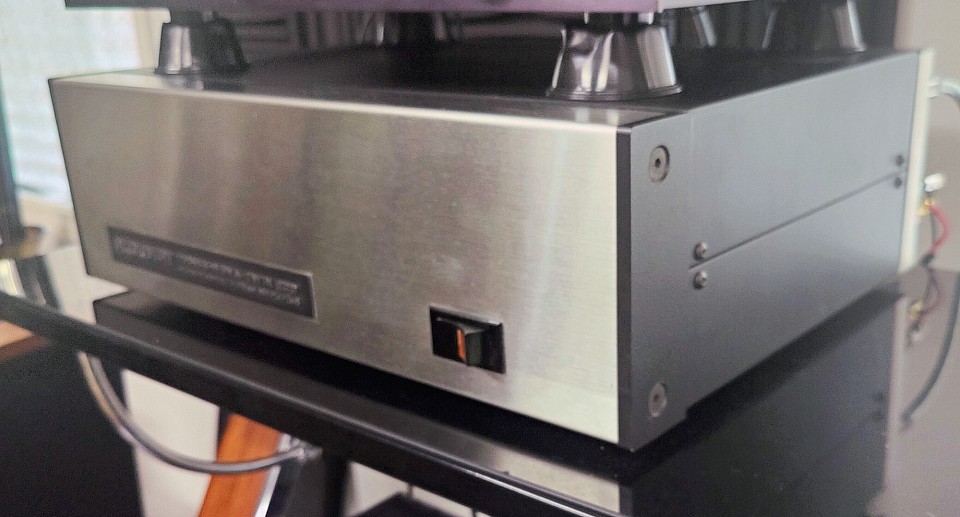
Acoustat Trans Nova Twin 200
Acoustat Trans Nova Twin 200
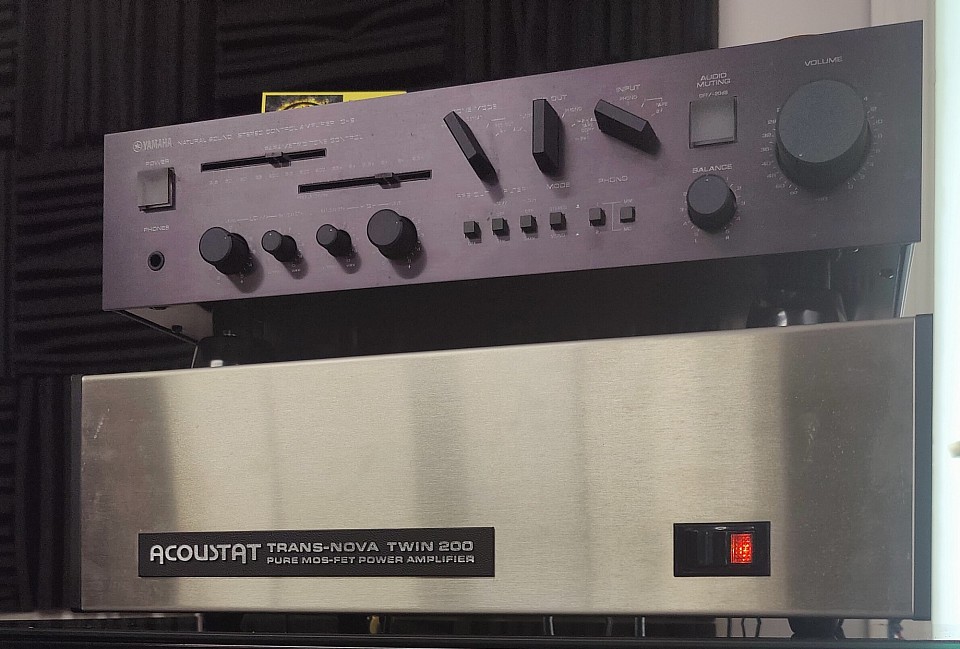
Acoustat Trans Nova Twin 200 (shown with Yamaha C2 preamp - not included)
amp (early 80's) 200 WPC $750
In pristine cosmetic condition, fully serviced and tested, this Acoustat Twin 200 stereo amplifier underwent a thorough bench servicing that included the tricky bias adjustment. Main cap values are well within original values; the interior of the unit is super clean as well. The amp had previously been used very sparingly by the original owner.
This powerful amplifier delivers just over 200 watts per channel over the entire range of audio frequencies from 20 Hz to 20 kHz for its rated harmonic distortion level of 0.1%.
(NOTE: the following technical description was provided by Gamma Electronics:
https://www.gammaelectronics.xyz/audio_03-1983_acoustat.html
The front panel is totally devoid of any controls, with the exception of its rocker-type power on/off switch. A rather prominent nameplate identifies the maker and the product. As for the rear panel, most of it is taken up with a massive heat sink, but there is just enough room at either end to accommodate color-coded, five-way output binding posts and an input jack for each channel. This sort of channel isolation is carried on inside the chassis as well, with completely separate modules housing the parts for each channel. Six fuses are located internally (four d.c. supply-voltage line fuses and two a.c. line fuses). The TNT-200 uses four completely separated bilateral power supplies and a twin-core, quasi-toroidal power transformer with parallel primaries.
"Trans-Nova" is an acronym for "Trans-conductance Nodal Voltage Amplifier." Most power amplifier output stages are typically configured either as voltage followers or as transconductance stages (common in tube-type amplifiers). When Acoustat decided to design an amplifier employing MOS-FETs as power output devices, they found that neither of these basic configurations was well suited to such ICs.
Basic specs:
Power output: 200 watts per channel into 8Ω (stereo)
Frequency response: 20Hz to 20kHz
THD: 0.1%
Impedance: 4 ohms (minimum)
Power Consumption: 100 watts idling, 750 watts at rated power.
Weight: 40 lbs
Dimensions: 17.5"W x 14"D x 5.5"H
About Acoustat...
Acoustat was an American company known for its full range electrostatic speakers that began its research in the early 1970s and introduced its first commercial model, the Model X, in 1976-77. After pioneering advances in electrostatic technology and achieving critical acclaim, the company filed bankruptcy in 1984 and was subsequently bought by David Hafler. The brand's history is marked by innovation in electrostatic panel design and amplifiers, leading to a loyal following among audiophiles and recording studios before its acquisition and subsequent market disappearance in the U.S. in the early '90s.
+++++++++++++++++++++
+++++++++++++++++++++
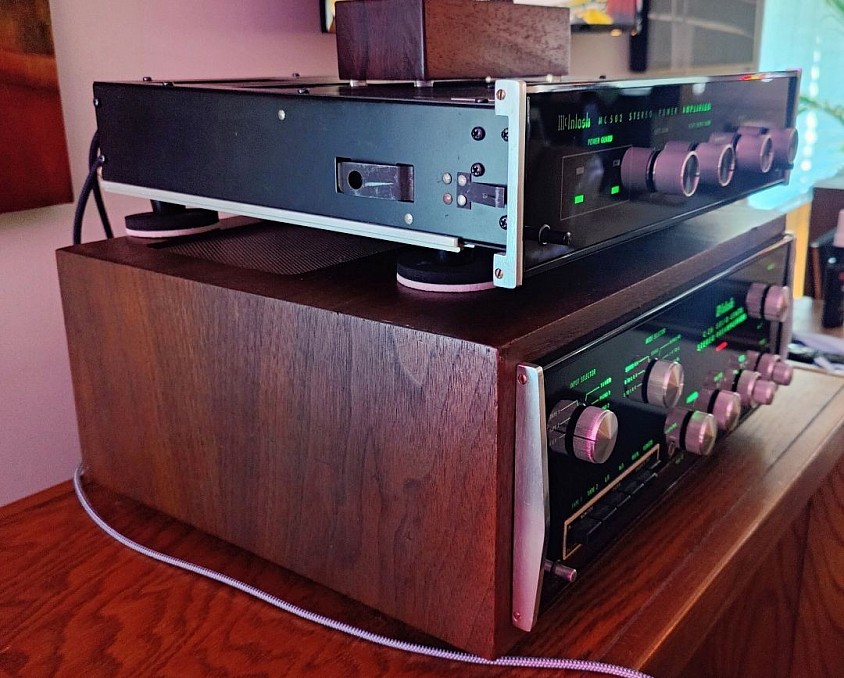
McIntosh C26 / MC-502
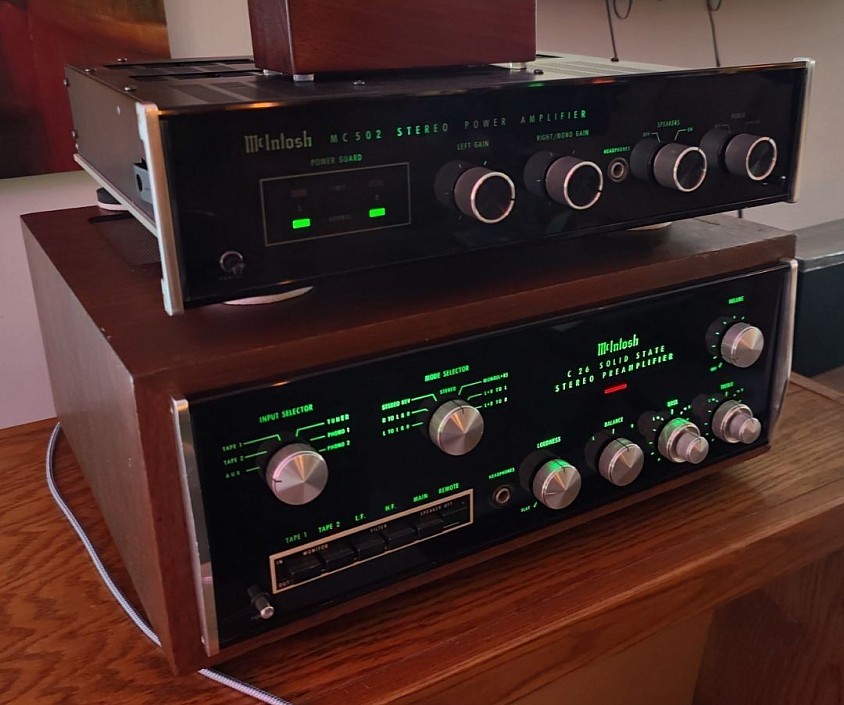
McIntosh C26 / MC-502
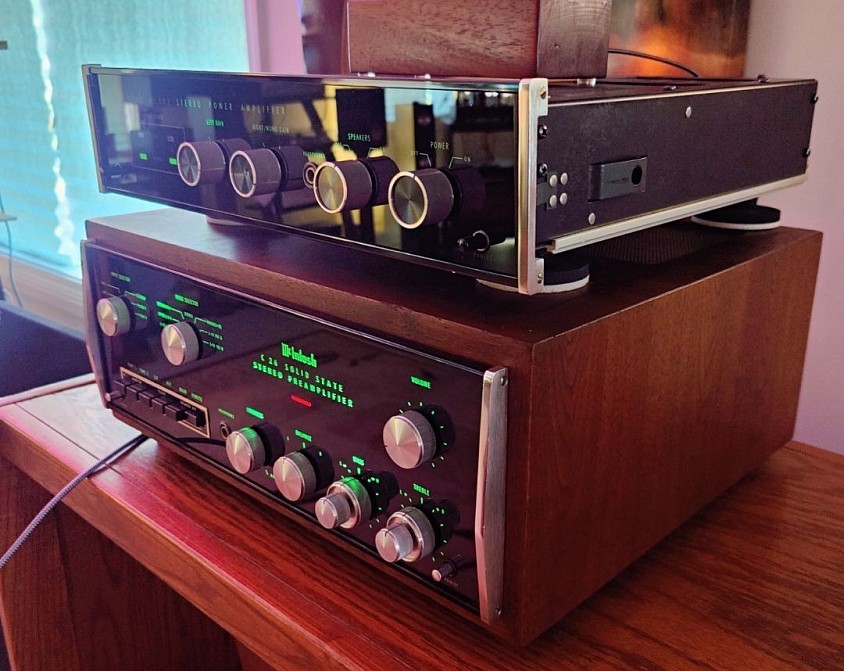
McIntosh C26 / MC-502
McIntosh C-26 / McIntosh MC-502
C-26 preamp $1600
MC-502 amp ('78-'89) 50 WPC $1200
Fully bench serviced, fully tested and fully functional, this beautiful McIntosh Mc502 is a compact, non-metered amp with a brand new black glass faceplate, green backlit lettering and red led's. It features separate gain controls for each channel. The amp also has the power switch in front, headphone jack and speaker on/off switch. Fortunately, it also has the Mcintosh "powerguard" feature and the "sentry monitor" feature. The MC-502 is based on the same design concept as the McIntosh C504 preamp.
NOTE: This amp does not come with the factory designed L54 wood case. However, as an affordable option, we do offer our own in-house, custom built covers made with your choice of different exotic wood types (walnut, oak, bloodwood, etc).
At this price, it's a no-brainer for anyone who's always wanted to get into McIntosh but was hesitant at spending a ton of money!
The Powerguard:
The Normal (green) and Limit (red) lamps on the front panel are operated by a proprietary circuit called a waveform comparison circuit. In this circuit, the Limit lamp lights up and the Normal lamp goes out when the difference between the output waveform and the input waveform is 0.5%. When the difference reaches 1%, the power guard circuit operates to prevent clipping of the amplifier, to prevent distortion from being reproduced from the speaker, and to protect the speaker safely.
Specs:
50 WPC into 8 ohms,
75 WPC into 2.7 to 4 ohms. (150 WPC mono into 8 ohms).
Frequency response: 20-20kHz (+0 -0.25dB).
THD: 0.02%.
Output direct-coupled for 2.7 to 8 ohms.
Headphone Impedance: Low
Dimensions: 16"W x 3,6"H x 14.5"D
Weight: 27 lbs
McIntosh C26 preamp
In very good cosmetic condition and also fully bench serviced and tested, this McIntosh C26 preamp was considered one of their upgraded (redesigned) preamps and featured the highly touted differential input circuit that literally reduced phono input noise to negligible levels. This one is 100% original all knobs, lamps, switches, etc in working order. A genuine McIntosh "Panlock" wood case, in very good condition, is included.
+++++++++++++++++++++++++++
+++++++++++++++++++++++++++